
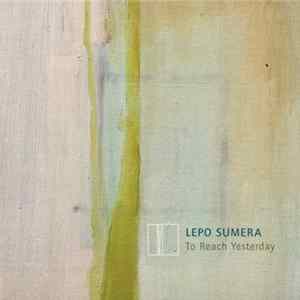
Lepo Sumera - To Reach Yesterday Album
 Performer:
  Genre:
  Title:
  MP3 album size: 2133 mb
 Style: Contemporary
Tracklist
| 1 | Scenario Bass Clarinet – Meelis VindFlute – Neeme PunderPiano – Lea Leiten | 10:51 |
| 2 | Pardon, Fryderyk! Piano – Lea LeitenTap Dance – Alexander Ivashkevitch | 8:26 |
| 3 | The Silent Odalisque Flute – Neeme Punder | 6:33 |
| 4 | To Reach Yesterday Cello – Aare TammesaluPiano – Lea Leiten | 10:53 |
| 5 | Nº. 128 My Music Piano – Marje LohuaruSoprano Vocals – Pille Lill | 3:27 |
| 6 | StarsPiano – Pille LillSoprano Vocals – Marje Lohuaru | 4:33 |
| 7 | The Piece From The Year 1981Piano – Lea LeitenTap Dance – Alexander Ivashkevitch | 5:53 |
| 8 | Nº. 121 'Tis Better To Be Vile Piano – Pille LillSoprano Vocals – Marje Lohuaru | 2:18 |
Notes
All the musicians introduced on the CD have graduated from the Estonian Academy of Music and were noticed in the music life still as students. They are active in different areas of music life, performing as soloists, playing in orchestras and/or various ensembles, and teaching young musicians. In many cases, they worked together with Lepo Sumera at his lifetime, preparing the first performances of his works. The instrumental works were recorded by The Reval Ensemble. Reval was the historical name of Tallinn, The Reval Ensemble performs primarily contemporary music. Their repertoire includes works by George Crumb, York Höller, Arvo Pärt and Erkki-Sven Tüür, works by young Estonian composers. The musicians had performed together in concerts before, but found the name for the ensemble in 1999, for their concert at the NYYD ‘99 – the 7th international festival of contemporary music in Tallinn.
The line-up of the ensemble varies according to the works they perform. The artistic director and cellist Aare Tammesalu, flutist Neeme Punder, and pianist Lea Leiten form the core of the group. Aare Tammesalu started to participate in concert life in the 1980s. He is a member of the orchestra of the Estonian National Opera. Lea Leiten is one of the most appreciated young piano accompanists and ensemble players in Estonia. She has collaborated with numerous singers and musicians. Neeme Punder plays the flutes of different periods and is known as an excellent interpreter of Renaissance and Baroque music. From the late 1970s he has been the flute soloist of the renowned ensemble of early music, Hortus Musicus. He has performed with other early music ensembles in Estonia and abroad, and with the Estonian-Finnish Baroque Orchestra. With his vivid musical imagination he is also an appreciated musician on the scene of contemporary music. Meelis Vind is a member of the Estonian National Symphony Orchestra and belongs to the best well-known Estonian ensemble of new music, the NYYD Ensemble. He also is in high esteem as jazz musician and improviser. Alexander Ivashkevitch who performs the “percussion part” in Pardon, Fryderyk!, is an actor of the Russian Drama Theatre in Tallinn; tap-dance is his great love and hobby.
After graduating from the Estonian Academy of Music, Pille Lill has studied singing in Sibelius Academy in Helsinki, in Italy, Denmark, Moscow, and, for several years, in the Guildhall School in London. The list of her opera roles includes Purcell’s Dido, Mozart’s Countess and Pamina, Verdi’s Elisabeth, Violetta and Desdemona, Puccini’s Mimi, Cho-Cho-san, Tosca and Liu, and Barbara in Barbara von Tisenhusen by Eduard Tubin. Likewise is her warm soprano expected on concert stages where she performs solo parts in Requiems by Mozart and Verdi, in Beethoven’s Ninth and Mahler’s Eight symphonies, in the oratorio Des Jona Sendung by Rudolf Tobias, etc. She is an appreciated singer of chamber music as well, and several contemporary Estonian composers have written new works for her. Marje Lohuaru took her post-graduation course at the St. Petersbourg Conservatory. At present she is a professor of the Department of Chamber Music at the Estonian Academy of Music and plays in various instrumental ensembles, which have performed in Germany, Scandinavian countries, and Canada. As an excellent piano accompanist, she has worked with the best Estonian musicians and singers. Her musical partnership with Pille Lill began in 1995.
LEPO SUMERA (1950-2000) was one of the most striking personalities in contemporary Estonian music. He was considered the greatest living symphonist in Estonia, and a pioneer in electro-acoustic music. He was one of the central figures in the cultural life of Estonia. In the times of the country’s re-awakening in the late 1980s he belonged to the influential group of Estonian intellectuals generating ideas and strategies for social and political changes. In 1989-1992 he served as Estonia’s Minister of Culture. In 1993 he was elected the chairman of Estonian Composers’ Union by his colleagues; re-elected twice, he hold the post until June 2000 when he died from a heart failure. Lepo Sumera studied composition with Veljo Tormis at Tallinn Music High School and, from 1968, with the renowned Professor Heino Eller at the Estonian Academy of Music. After Prof. Eller’s death he studied with Heino Jürisalu, graduating 1973. He took post-graduate studies at Moscow Conservatory 1979-1982. Sumera worked as recording engineer and producer at Estonian Radio in his youth. He began teaching composition at the Estonian Academy of Music in 1978 and was appointed a professor in 1993. He was one of the founders of the studio of electronic music at the Music Academy and worked as its first director in 1995-1999. He also lectured in the Summer Courses of New Music in Darmstadt (1988, 1989) and in Musikhochschule in Karlsruhe . Works by Lepo Sumera have been performed in majority of the European countries, in the USA, Canada and Australia, and on Cuba. He took part in the festival ‘Composer-to- Composer’ in Telluride, Colorado . In 1989 he was composer-in-residence at the festival New Beginnings in Glasgow and, in 1993, special guest at the Sydney Spring Festival of new music and the Norrtälje (Sweden) Chamber Music Festival.
He was awarded numerous annual music prizes and four state prizes in Estonia, and a prize for the best film music score at the international festival of animation films in Espinho (Portugal). His Fifth Symphony was chosen the 1st recommended work at the International Rostrum of Composers in Paris in 1996. Sumera’s musical language demonstrates his individual approach to contemporary composition techniques. He preferred unorthodox – blending or contrasting – use of them (similar approach appeared later in works of his younger colleague, Erkki-Sven Tüür). Among Estonian composers and musicians, he was always one of the persons best informed in contemporary music. There is no reason to speak about the ‘iron curtain’ (which, in fact, functioned properly only until the middle 1950s) in connection with Sumera’s music, albeit the history of rising his ‘quasi-minimalist’ works written between 1981 and 1986 has suggested the idea to some western critics. It is true that American minimalism was unknown in Estonia until 1983 and Sumera learned his repetition technique from the archaic Estonian ‘runo’ song. But minimalism was noticed relatively late also in the West-European countries, in the Scandinavian countries it had been ‘discovered’ only a few years earlier than in Estonia.
As for Sumera’s works of that period, his treatment of overall form differs completely from the intentionally static forms of American minimalists. The symphony orchestra was his favourite medium. His symphonic works display an imaginative use of orchestral colours and remarkable skill in creating large form arches. His list of works includes two ballets – Anselm’s Story (libretto by Mai Murdmaa after E.T.A. Hoffmann) and The Lizard (Andrei Petrov after Alexander Volodin, 1987/93) –, six symphonies (1981-2000), a Piano Concerto (1989/93), Cello Concerto (1998/1999), and Concerto Grosso with three solo instruments (soprano saxophone, percussion, and piano).
From the late 1980s electro-acoustic music continually gained significance in his work; he was interested especially in live electronics. He also created multimedia works, including two based on particularly ingenious ideas: in a multimedia chamber opera Olivia’s Master Class (libretto by Peeter Jalakas after the novel of Ervin Õunapuu; 1997), paintings by Caspar David Friedrich (one of the main characters of the opera) were used for video; the entire material for Heart Affairs was derived from sounds and rhythms of a human heart, and from its ‘portrait’ produced by echocardiography.
An appreciated author of chamber music, he was always asked to write new pieces by musicians. Majority of his instrumental chamber works contain different aleatory sections. However, he never applied random structures to overall shape of the work. There is a peculiar semantic casting in Sumera’s output. In his symphonies he wrote down his most serious and painful experience, none of the six reveals the person with a vivid sense of humour behind them. Even his instrumental concertos are close to the symphonies in this respect. Many of his chamber music and chorus works display all grades of humour, from the playful and delicate one to the bold grotesque. Scenario for flute, bass clarinet and piano was written for the Netherlandish HET-Trio. As the title suggests, the piece has a clear dramatic outline and evolves diverse musical events, based on contrasts of dynamics, texture, tempi, etc. The stylistic means, likewise versatile, can undoubtedly be associated with post-modern irony, which, nevertheless, contains no acrimony – a playful, joyous approach is hold throughout the piece, up to its “clowning” conclusion (slightly theatricalized in live performances). In two decades, Two Pieces from the Year 1981 have become classics in Estonian piano music. The first piece had a special significance for Sumera’s work. It marks a turning point in his musical idiom: having written in a more complex style with use of the free dodecaphony in the 1970s, he then applied natural diatonic scales in all of his works of the early 1980s, and occasionally later. His First Symphony was born from the same piano piece, since, according the composer, its theme “asked for orchestral colours”. The symphony was a great success. However, the piano piece with its strangely fascinating theme – a long motif chain that seems to strive into infinity – continued living its own life and became his most frequently performed work, a kind of his musical cachet. Sumera did not find the individual title for the piece; when performed separately, it is titled as The Piece from the Year 1981. The second piece Pardon, Fryderyk! is a collage on Mazurka a-moll op. 17 no. 4 by Chopin. The quasi-improvised middle part includes a section of actual improvisation and could be compared with a long slowed film cadre. According to the composer’s written instructions, the percussive rhythms are usually accomplished by the pianist’s drumming by hand on his /her instrument’s corpus. But Sumera had also an adventurous idea of using tap-dance rhythms instead (he even imagined that, in a live performance, the pianist could dance on the stage), yet the first result of his vision can be heard on this CD.
In both pieces a varied rhythmic pattern of the right hand is coupled with guileless Alberti basses in the left one. In fact, rhythm was Sumera’s main interest in these pieces. Twelve years later he wrote in his commentary: “At the time I was, and still am interested in the relationship between two parts in texture, in this case between the parts of two hands, when each has its own material, whereby one of them is changing, but the other is not. Both materials are static, changes in one of them create a strange effect of fatality in both rhythm and melody”. Silent Odalisque was the first of four musical portraits of graceful and capricious characters and the only one written for flute solo – in 1999 the piece was followed by Dancing Odalisque, Singing Odalisque, and Sorrowful Odalisque, all three scored for flute, guitar and cello. To Reach Yesterday was commissioned by Sydney Spring Festival. Introspective melodic patterns in cello part emerging among the anxious chromatic figures – perhaps the piece is about yearning for the more melodic music of past times? It may be read even in this way, but different other plots would be as convincing. Sumera never specified his narratives, the “plot” taking place in the musical material was most significant for him. As for titles, he usually began to think about one after completing the piece. He found the name To Reach Yesterday ... due to crash of the hard disc on his computer. He lost his files, including the one with the new piece. Since the deadline was there and the piece was to be sent to Sydney, he spent a night at “restoring yesterday” – putting it down by memory, in handwriting. Until the 1990s Sumera seldom wrote vocal works, though two of his then three cantatas,
The Mushroom Cantata (1979/83) and The Song of Island Maiden from the Sea belong to his most significant works. In an interview he admitted: “I cannot get over the problem that when I find a good text, then it already has a fine sonorous quality, and I see no reason to add music to it. On the other hand, why should I write music to a poor text?” In 1990s he discovered for himself new possibilities of the human voice and the word performed by singing. The year 1996 started a wave of vocal works, beginning with too entirely different cycles: the humorous Songs from Estonian Matrimonial Poetry (text from folklore) for baritone and piano, and the intense, painful Three Sonnets of Shakespeare (No 104, 90, and 8) for soprano, speaker, boys’ chorus and orchestra. In 1999 another set of Shakespeare sonnets – No. 128 (My Music) and No. 121 (‘Tis better to be vile) for soprano and piano – appeared. The two songs were written for Pille Lill, so was Stars on text by Marie Under (1883 – 1980), a beloved Estonian poetess who lived as emigrant in Sweden since 1944. Like the lyrics of her last decades, the poem Tähed /Stars (from the early 1950s) is marked by a tragic longing for home and an elaborate simplicity in form.
Merike Vaitmaa
Album
Посмотреть сведения об участниках альбома, рецензии, композиции и приобрести альбом 2003 CD от To Reach Yesterday на free to Lepo Sumera Lepo Sumera: To Reach Yesterday Scenario for Flute, Bass Clarinet and Piano, Two Pieces from the Year 1981: The Piece from the Year 1981 and more. 8 tracks 53:19. Sumera - To Reach Yesterday. TITLE added to MP3 cart. LEPO SUMERA: To Reach Yesterday. Lepo Sumera. September 14, 2003. Exclusive Prime pricing. to buy. Get Album Info. Lepo Sumera: To Reach Yesterday. Released by Megadisc Classics Sep 2003 8 Tracks. Play all. Listen to all songs in high quality & download Lepo Sumera: To Reach Yesterday songs on . To Reach Yesterday Aare Tammesalu Lea Leiten Lepo Sumera. 2003 Megadisc. Released on: 2003-09-14. Auto-generated by YouTube. Has been played on. Estonia 4. Various Artists. Lepo Sumera: Film Music. Your Rating. Overview . Lepo SUMERA 1950-2000 To Reach Yesterday Scenario for flute, bass clarinet and piano 1995 Two Pieces from the Year 1981 for piano The Silent Odalisque for flute solo 1997 To Reach Yesterday for cello and piano 1993 Two Sonnets of Shakespeare for voice and piano 1999 Stars for voice and piano 2000 Pille Lill soprano Marje Lohuaru piano The Reval. Chamber Hall of the Estonian Academy of Music. DDD MEGADISC MDC 7814. Had the life of Lepo Sumera not been cut tragically short by heart failure in 2000 at the premature age of fifty, I suspect that his music would have been far better known to British audiences. Lepo Sumera 8 May 1950 2 June 2000 was an Estonian composer and teacher. He was born in Tallinn and studied with Veljo Tormis in his teens, and from 1968, with Heino Eller at the Estonian Academy of Music and Theatre then Tallinn State Conservatory. After Heino Eller's death in 1970, he studied with Heino Jürisalu, graduating in 1973. He then did postgraduate study at the Moscow Conservatory 19791982 with the Russian composer Roman Ledenev. Sumera first came to notice in 1972 with In Memoriam
Related to Lepo Sumera - To Reach Yesterday

Discussed
Loefah - Woman / MidnightEd Rush, Optical & Fierce - Cutslo (Lokuste Mix) / Alien GirlThe 1975 - FallingforyouSlowdive - SlowdivePanchiko - D>E>A>T>H>M>E>T>A>LMetallica - ...And Justice For AllNeil Young - Harvest MoonMerle - 2000 (And We're Still Here)Various - Techno! The New Dance Sound Of DetroitMickey Finn And Aphrodite - Bad Ass !Levon Vincent - Solemn Days EPMoodymann - ABCDElliott Smith - Figure 8The Velvet Underground - White Light/White HeatV.I.V.E.K - Square OffMike Huckaby - Baseline 87'David Bowie - Hunky DoryPépé Bradock - 6 Millions Pintades EPJosé González & The String Theory - Live In EuropeUnknown Artist - ODECrumb - Crumb / Locket2814 - Pillar / New SunCar Seat Headrest - Teens Of DenialCarly Rae Jepsen - E•MO•TIONJoey Bada$$ - 1999Fripp & Eno - Evening StarThe Beatles - The BeatlesStereolab - Peng!Fallout - The Morning AfterVitalic - Poney EPAqua Fina - Disco Trax EP (Classic Future Funk Vol. 1)Bowery Electric - BeatDavid Bowie - Nothing Has ChangedVarious - Full Beam For Gees OnlyAleke Kanonu - AlekeWeyes Blood - Titanic RisingDavid Bowie - Aladdin SaneAIR - Music For MuseumFleet Foxes - Fleet FoxesHuerco S. - Colonial PatternsJoy Division - CloserAhmed Fakroun / Belle Epoque - Yo Son (Edit De Prince Language) / Bamalama (Edit De Lee Douglas)The Beatles - Abbey RoadElecktroids - ElektroworldYagya - Rhythm Of SnowMike Dunn Presents Mr. 69 - Phreaky MFUnique - I'm UntouchableChemotex - ThulsaDepeche Mode - Speak & Spell | The 12" SinglesMoodymann - Inspirations From A Small Black Church On The Eastside Of DetroitOzzy Osbourne - OzzmosisJames Horner - Aliens (Original Motion Picture Soundtrack)Jack & The Mods - The Jack Mod KickLanark Artefax - Whities 011UC Beatz - Untitled Track 1 / Untitled Track 2Small Faces - There Are But Four Small FacesSonic Insomniac - ScorpioRon Trent / Joshua / Abacus / Chez Damier - The Foot Therapy EPBukem & The Peshay - 19.5Black Sabbath - The Vinyl Collection 1970-1978Subnation - Scottie / Somebody Always DiesJessie Rogers - One Monkey Don't Stop No ShowMillsart - Axis Copper EditionA.R. & Machines - The Art Of German Psychedelic 1970-74Acronym - MalmMr. Bungle - Mr. Bungle:zoviet-france: - MohnomisheCrass - The Feeding Of The Five ThousandKyuss - Blues For The Red SunForgemasters - Track With No NamePiledriver - Stay UglyKraftwerk - Computer WorldSling And Samo / SSPS - DJ Tool #1 / BigoteRide - Weather DiariesCarpenter Brut - Leather TeethBurzum - FilosofemGerry Cinnamon - Erratic CinematicRootstrax - HarlequinEvery Time I Die - SalemLJ Reynolds / René & Angela - Trust In Me (Extended Mix) / I Love You More (Instrumental Edit)The Shider Family Band - Keep You BurningDeerhunter - Halcyon DigestVarious - The Past And Present EPMinimal VisionThe Mothers Of Invention - We're Only In It For The MoneyYoung Echo - Young EchoCode Of Practice - Can We Change The Future RemixesHappy Tunes / Midas - Rushin' On Pink Champagne / Imperial March (Star Wars Mix)Dinosaur Jr - Where You BeenB12 - Time TouristSpooky - GargantuanVarious - The Art Of The 12" (A Celebration Of The Extended Remix)Mayhem - De Mysteriis Dom Sathanas AliveEmperor - In The Nightside EclipseThe Killers - Hot FussThe Police - Message In A Box (The Complete Recordings)The Offspring - AmericanaUntold - Change In A Dynamic Environment EP 1Liz Phair - Exile In GuyvilleStray Cats - Runaway Boys